
About Us
English
Views: 266 Author: Warmed Publish Time: 2026-11-13 Origin: Site


Content Menu
● LED Solar Street Lights vs. Split Solar Street Lights: What Are We Comparing?
>> Integrated solar street lights
● What "Limited Installation Space" Actually Means
● Integrated vs. Split Solar Street Lights: Practical Comparison
● When Integrated Solar Street Lights Suit Restricted Sites
>> Fewer components can simplify deployment
>> Confirm that compactness does not restrict performance
● When Split Solar Street Lights Make Better Use of Limited Space
>> Independent positioning can solve local shading problems
>> Cable routes become part of the design
● Size the Energy System Before Choosing the Housing
>> An illustrative energy-budget example
>> Use seasonal conditions, not only annual averages
● Evaluate Lighting Quality, Not Just Advertised Wattage
● A Five-Step Site Assessment for Space-Constrained Projects
>> 1. Document the actual constraints
>> 3. Confirm structural feasibility
>> 4. Compare equivalent designs
>> 5. Define acceptance and maintenance requirements
● Compare Lifecycle Cost, Not Only Purchase Price
● Warmed's Approach to Project Selection
>> 1. Are integrated solar street lights always better for small spaces?
>> 2. Can split solar street lights work in shaded streets?
>> 3. Which configuration is easier to maintain?
>> 4. How many cloudy nights can a solar street light operate?
>> 5. Is a higher-wattage LED always the better choice?
>> 6. What should I request before placing an order?
At Guangdong Warmed Intelligent Technology Co., Ltd., we approach "LED Solar Street Lights vs. Split Solar Street Lights for Limited Installation Space" as a site-planning decision—not simply a product comparison. A compact fixture can simplify installation, but a separate solar panel may solve an exposure problem that an integrated unit cannot.
Our recommendation is straightforward: choose an integrated system when the lighting position also provides adequate sunlight and mounting clearance. Consider a split system when the best location for illuminating the road differs from the best location for collecting solar energy.
The right solution must fit the site, meet its lighting requirements, and maintain an adequate energy balance through demanding seasonal conditions.
First, a terminology clarification: split solar street lights normally use LEDs too. "LED" describes the light source; "split" describes the arrangement of components.
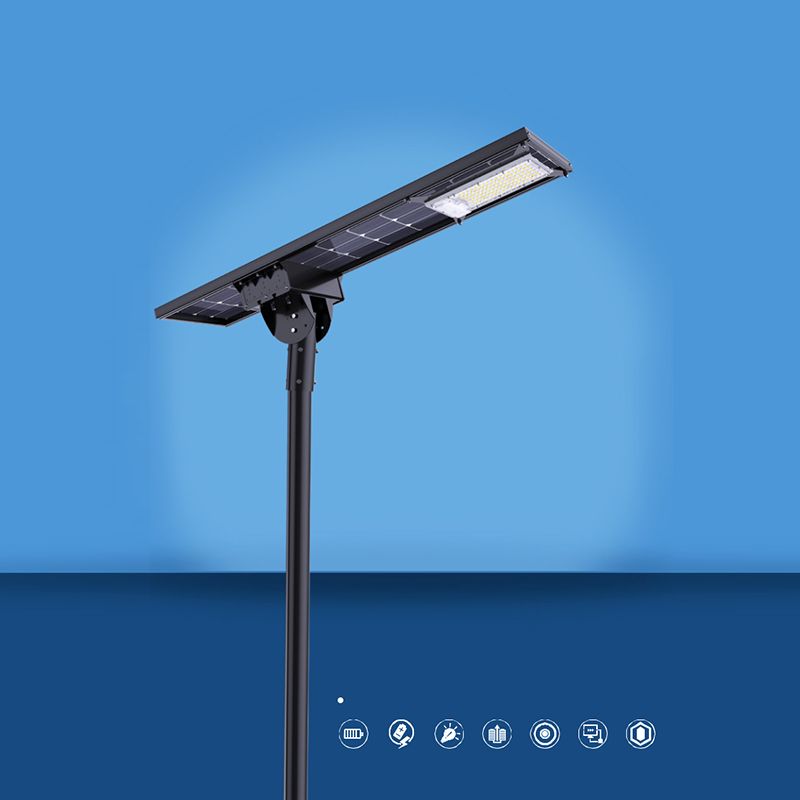
For this comparison, "LED solar street lights" means integrated, or all-in-one, solar LED street lights.
An all-in-one unit combines the solar panel, LED luminaire, battery, and controller into one assembly.
This arrangement reduces separate components and external connections. However, panel orientation and luminaire positioning may be linked, depending on the product's adjustment mechanisms.
A split system separates the photovoltaic panel from the luminaire. Battery and controller locations vary by design.
An all-in-two configuration commonly places the battery and controller within the lighting head while mounting the panel separately. Other split systems use separate battery enclosures.
Ask suppliers for component drawings rather than relying on product names alone.
A narrow pavement does not automatically favor an integrated fixture. Installation constraints occur in several different places.
- Ground space: Is there room for a compliant foundation without obstructing pedestrians or underground services?
- Pole space: Can the pole accommodate brackets, fixtures, cables, and maintenance access?
- Overhead space: Will panels or luminaires conflict with façades, trees, signs, or nearby infrastructure?
- Solar access: Is sufficient unshaded exposure available where the panel will sit?
- Service space: Can technicians safely clean panels and replace components?
Our starting question is therefore not "Which light looks smaller?" It is "Which part of this installation is constrained?"
That distinction prevents a common purchasing mistake: selecting the smallest assembly before checking whether it can harvest enough energy.
| Selection factor | Integrated system | Split system |
|---|---|---|
| Component arrangement | One main assembly | Panel and luminaire mounted separately |
| On-site assembly | Usually fewer component connections | Additional mounting and cable-routing work |
| Panel positioning | Depends on adjustment range | Greater independence from luminaire direction |
| Visual appearance | Often simpler and more compact | More visible brackets and components |
| Shading response | May require relocating the whole assembly | Panel can move to a better approved location |
| Future sizing flexibility | Constrained by product architecture | Potentially more flexible, subject to compatibility |
| Maintenance | Depends on access and internal design | Depends on component locations and connections |
| Structural requirements | Must be checked for the complete assembly | Must include panel area, brackets, and eccentric loads |
Neither configuration guarantees better reliability. Engineering quality, environmental suitability, installation workmanship, and maintenance planning remain decisive.
Integrated systems are strong candidates where clear sunlight and the required lighting position coincide.
Examples include an unobstructed pedestrian route, an open access road, or a compact parking perimeter with suitable mounting positions.
With fewer separate assemblies, an integrated unit may reduce installation steps and exposed cable runs. That can be valuable where access equipment, working hours, or traffic-management windows are restricted.
However, "easy installation" should never replace an approved installation method. Pole capacity, foundations, bracket compatibility, and safe access still require assessment.
Before specifying an integrated solar street light for a narrow road, check:
1. Whether the panel can receive adequate seasonal sunlight.
2. Whether the luminaire can achieve the required distribution without compromising panel orientation.
3. Whether the battery supports the specified nightly operating profile.
4. Whether the enclosure allows practical component replacement.
A smaller product is useful only when it can deliver the required service.
A split design becomes attractive when lighting and solar collection need different positions.
For example, a luminaire may need to illuminate a passage beside a building, while its panel requires an approved mounting point beyond the building's shadow.
Separating those functions creates options.
A separate panel may be positioned or angled more effectively than a panel tied to the lighting head.
However, splitting the components does not create sunlight. If the entire site remains heavily shaded, a different pole position, an engineered remote-panel arrangement, or another power supply may be more appropriate.
Remote positioning introduces electrical and installation considerations:
- Cable length and conductor sizing.
- Voltage drop and connector compatibility.
- Protection from abrasion, weather, and interference.
- Suitable cable entries and routing.
- Safe access to each component.
There is no universal maximum cable distance suitable for every system. The permitted arrangement depends on voltage, current, conductor size, controller requirements, and the manufacturer's instructions.
One of the largest gaps in solar street light comparisons is the absence of an energy calculation.
LED wattage alone does not establish nighttime performance. A useful assessment connects the operating schedule, solar resource, losses, battery capacity, and required autonomy.
Consider a hypothetical luminaire operating at:
- 30 W for five hours.
- 10 W for seven hours.
Its daily lighting demand is:
(30×5)+(10×7)=220 Wh
If the design assumes three equivalent peak-sun-hours per day and a combined solar-to-load efficiency of 75%, a simplified preliminary panel estimate is:
220÷(3×0.75)≈98 W
For two nights of autonomy, assuming 80% usable battery capacity and 90% battery-to-load efficiency:
(220×2)÷(0.80×0.90)≈611 Wh
These are illustrative calculations, not a product recommendation. They exclude project-specific allowances for aging, temperature, prolonged poor weather, and recovery after battery depletion.
The important insight is that installation space must accommodate the energy system—not merely the LED fixture.
Winter shading and weaker solar availability can determine whether an installation meets its operating schedule.
Peak-sun-hours are equivalent full-sun energy hours, not simply the number of daylight hours.
Solar assessment tools can support resource evaluation, but a grid-connected PV production estimate does not, by itself, demonstrate off-grid street-light autonomy.
A large wattage claim does not establish whether a narrow street will be illuminated appropriately.
Ask for a lighting calculation using the proposed mounting height, spacing, road geometry, and luminaire photometric data.
Review:
- Required average and minimum illumination.
- Uniformity across the relevant area.
- Glare and spill light near windows.
- Light distribution along the route.
- Suitability of the operating and dimming schedule.
Motion-responsive dimming may reduce energy demand, but it must remain compatible with the site's safety requirements and applicable lighting criteria.
We would not recommend solving an undersized energy system by reducing illumination below the project requirement.
Record road width, proposed pole positions, nearby structures, trees, underground services, and maintenance access.
Photograph the surroundings rather than only the intended mounting point.
Evaluate how obstructions affect the proposed panel position throughout the year.
A clear summer afternoon photograph does not establish winter suitability.
Have the pole, brackets, anchors, and foundation assessed for the proposed assembly and applicable local requirements.
A separate panel introduces additional area exposed to wind. An integrated assembly also requires a complete structural check.
Request integrated and split proposals against the same lighting target, operating schedule, autonomy requirement, and environmental assumptions.
Otherwise, a cheaper quotation may simply include less usable energy storage or lower nighttime output.
Agree on commissioning checks, programmed settings, installation records, warranty responsibilities, and replacement procedures before purchase.
Include nighttime verification and an appropriate observation period rather than accepting a brief switch-on test as proof of long-term performance.
Integrated products may reduce assembly work. Split products may offer more positioning flexibility. Neither observation establishes the lowest total cost for a particular project.
A useful quotation comparison includes:
- Equipment, poles, brackets, and foundations.
- Installation labor and access equipment.
- Cable protection and additional mounting work.
- Cleaning and inspection requirements.
- Battery replacement and spare-part availability.
- Warranty scope and service response.
- Expected disruption during repairs.
For a constrained site, maintenance access can be as important as installation speed. Confirm whether replacing a battery requires removing the whole fixture, opening an elevated enclosure, or accessing a separate service location.
Warmed combines LED lighting product distribution with technical services and system-level lighting support.
According to our company background, we hold distribution authorizations from multiple domestic and international lighting brands. Our team members' previous experience includes participation in the Great Hall of the People renovation, projects associated with China's General Administration of Sport, Guangzhou street-light upgrades, urban street-light improvements in Mexico, and a Stamford real-estate project in Australia.
These are team-member experience statements, not claims that Warmed contracted every project or that each involved solar lighting.
Our role is to help balance quality, cost, delivery, and service through a clearly defined specification.
For your project, send Warmed the location, site photographs, road dimensions, proposed mounting height, operating hours, and known space restrictions. Request a comparison of integrated and split configurations with documented lighting, solar-resource, battery, and installation assumptions.
No. They can simplify the assembly, but a split design may fit better when the luminaire and panel need different positions. Evaluate ground clearance, overhead clearance, sunlight, and servicing separately.
They can help when a suitable unshaded panel position exists nearby. They cannot compensate for persistent shading across every practical panel location.
It depends on access and product design. Check battery location, replaceable components, connector access, spare parts, and whether servicing requires lifting equipment.
There is no universal answer. Autonomy depends on usable battery energy, nightly demand, temperature, battery condition, and the energy collected during poor weather.
No. Select the luminaire through lighting calculations. Optical distribution, mounting geometry, uniformity, and glare matter alongside electrical input power.
Request the component layout, photometric files, battery capacity in watt-hours, operating profile, solar-sizing assumptions, structural requirements, installation manual, warranty terms, and maintenance instructions.
1. Guangdong Warmed Intelligent Technology Co., Ltd. — Company background supplied for this article. Source for business positioning, distribution authorizations, and team-member experience. No public verification page or customer reviews were supplied.
2. U.S. Department of Energy — [Outdoor Solar Lighting]. Background on solar cells, battery storage, and nighttime outdoor lighting. [energy]
3. U.S. Department of Energy — [Solar Ready Buildings Planning Guide]. Guidance on solar access, obstruction assessment, and the effects of shading on photovoltaic performance. [www1.eere.energy]
4. U.S. Department of Energy — [Solar Photovoltaic Specification, Checklist and Guide]. Reference for site assessment and accounting for permanent and seasonal shading. [www1.eere.energy]
5. U.S. Department of Energy, Better Buildings — [PVWatts Calculator: NREL Tool]. Establishes that PVWatts estimates grid-connected photovoltaic production; it is not standalone proof of battery autonomy. [betterbuildingssolutioncenter.energy]
6. U.S. Department of Energy, Better Buildings — [Exterior Lighting Control Guidance]. Background on exterior lighting controls and reduced-power operating strategies. [betterbuildingssolutioncenter.energy]
7. RoadSmart — [Integrated Solar Street Light Design: Installation & Care]. Supplementary industry reference on component arrangements, independent panel placement, installation documentation, and electrical compatibility. [roadsmartsolar]
Hot Tags: China, Global, OEM, private label, manufacturers, factory, suppliers, manufacturing company


