
About Us
English
Views: 247 Author: Warmed Publish Time: 2026-11-04 Origin: Site


Content Menu
● Why Warmed Starts With the Venue, Not the Product
● Solar String Lights vs. RGB Outdoor Lights: Understand the Real Difference
● Weather Exposure: Check the Entire Lighting System
>> What IP65 and IP67 Actually Tell You
>> Inspect Connectors, Controllers, and Mounting
● When Solar String Lights Make Sense
>> Assess Sunlight Where the Panel Will Actually Sit
>> Ask What the Runtime Claim Includes
● When RGB Outdoor Lights Are the Better Fit
>> RGBW Deserves Attention Where People and Food Matter
>> Test Control Failure, Not Just Color Effects
● A Better Design: Separate Lighting Into Three Layers
>> Layer 1: Functional Lighting
>> Layer 3: Accent and Event Lighting
● Turn Runtime Promises Into an Energy Budget
● Compare Lifetime Cost, Not Just Purchase Price
● A Practical Acceptance Test Before the First Event
● Weatherproof Lighting Does Not Make an Event Weather-Safe
● Plan Your Outdoor Lighting With Warmed
>> Can solar string lights operate after cloudy days?
>> Are RGB outdoor lights waterproof?
>> Is IP67 always better than IP65?
>> Can RGB lights produce suitable white light?
>> Which option is cheaper over time?
>> Can decorative lights provide emergency lighting?
Guangdong Warmed Intelligent Technology Co., Ltd. helps customers approach outdoor lighting as a complete system—not simply a collection of fixtures. When comparing solar string lights vs. RGB outdoor lights for weather-exposed event venues, our starting point is straightforward: choose lighting that delivers the required atmosphere without compromising operating reliability, maintenance access, or safety.
Solar string lights can create welcoming spaces without extending mains power to every decorative position. RGB outdoor lights offer adjustable colors and coordinated scenes. Neither is automatically the better choice for rain-exposed gardens, coastal terraces, wedding lawns, or open-air hospitality venues.
The right solution depends on what must stay illuminated, how long events run, where equipment is installed, and what happens when conditions deteriorate.
At Warmed, we combine LED lighting distribution with technical services and systematic lighting solutions. Our company profile includes distribution authorizations from multiple domestic and international lighting brands.
Our team members' previous project participation includes the Great Hall of the People renovation, projects associated with China's General Administration of Sport, Guangzhou street-lighting upgrades, urban street-lighting projects in Mexico, and an Australian Stamford real estate project.
These are team experience credentials, not a claim that Warmed contracted every project.
Our approach is to balance quality, cost, delivery, and service. For event venues, that means asking an operational question before discussing decorative effects: what must the lighting system continue doing when the weather, schedule, or power conditions change?
This comparison involves two different characteristics.
"Solar" describes the power source. "String lights" describes the arrangement of the luminaires. "RGB" describes color generation using red, green, and blue light.
A solar string can include RGB LEDs. An RGB outdoor fixture can operate from mains electricity, a battery, or a solar-powered system.
For this guide, the practical comparison is between standalone solar-powered decorative strings and externally powered RGB or RGBW outdoor lighting.
| Decision factor | Solar string lights | Externally powered RGB/RGBW lights |
|---|---|---|
| Main role | Decorative ambiance | Color scenes and architectural accents |
| Energy dependency | Sunlight, panel placement, battery condition | External supply and distribution |
| Scheduling | Limited by stored energy and controls | More predictable with adequate power |
| Installation | Less need for mains distribution to decorative points | Requires planned power and control routing |
| Maintenance | Panels, batteries, strings, connections | Fixtures, drivers, connections, controllers |
| Best application | Flexible, noncritical decorative areas | Coordinated events and repeatable scenes |
| Main limitation | Variable charging and runtime | Greater installation and control complexity |
The important distinction is not "simple versus professional." It is whether the complete system meets the venue's operating requirements.
An IP rating describes enclosure protection against solids and water under specified test conditions.
- IP65 indicates a dust-tight enclosure protected against water jets.
- IP67 indicates a dust-tight enclosure protected against the effects of temporary immersion.
Neither label means "safe in every outdoor condition." An immersion rating should not be treated as proof of resistance to every type of water jet.
IP ratings also do not establish wind resistance, salt-corrosion performance, UV durability, or suitability for every electrical installation.
For exposed event venues, request documentation for the assembled configuration—not just the lamp housing.
A protected fixture can still fail if another component is unsuitable.
Review:
- Cable joints and end caps.
- Plug, driver, and controller locations.
- Solar-panel cable entries and battery enclosures.
- Drainage around installation points.
- Manufacturer-approved mounting methods.
- Exposure to wind, sunlight, irrigation, and coastal air.
Keep connections away from pooling water and follow the manufacturer's installation instructions. Have a qualified installer determine required electrical protection and compliance with local rules.
For suspended strings, do not assume the electrical cable can serve as a structural support. Use the specified mounting arrangement and obtain structural advice where necessary.
*Suggested visual: An annotated installation photograph showing supported strings, protected connections, panel placement, and drainage.*
Solar string lights are worth considering when a venue needs decorative lighting in locations where extending power would be inconvenient or disruptive.
Examples include garden seating, seasonal installations, and secondary hospitality areas. Their suitability still depends on the lighting demand and available sunlight.
A sunny venue does not guarantee a well-charged solar lighting system.
Panels may be shaded by trees, temporary tents, banners, or nearby buildings. Charging also varies with weather, season, dirt accumulation, and installation orientation.
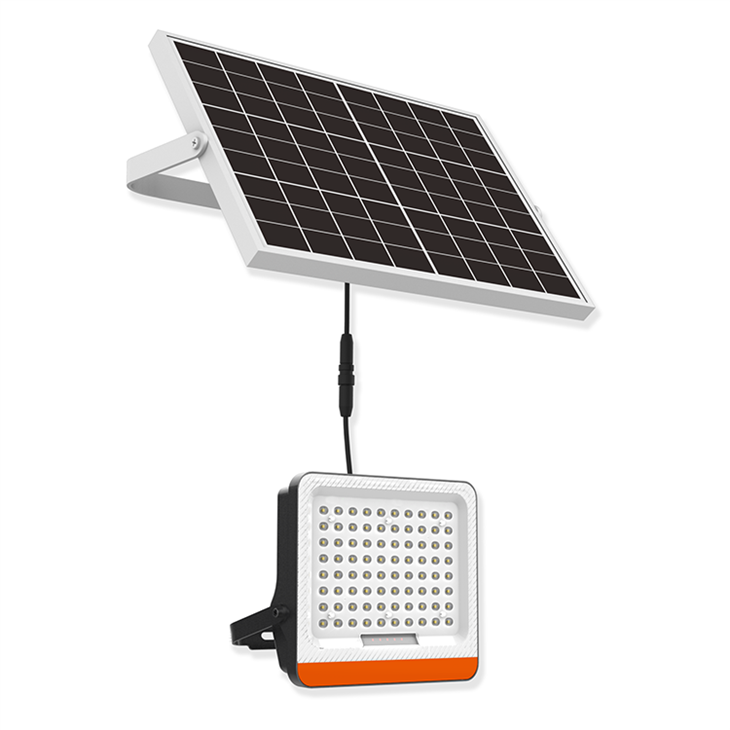
Evaluate the actual panel position during the months when events operate. For a shaded dining area, a product with a separately positionable panel may be more practical than an integrated-panel design.
"Up to 12 hours" is incomplete without test conditions.
Ask suppliers:
1. Which brightness setting was used?
2. Was the battery fully charged beforehand?
3. Does the product dim automatically?
4. What temperature applied during testing?
5. Is the battery replaceable?
6. What happens after consecutive low-charge days?
We would not select decorative solar strings as the sole lighting for exits, steps, or other safety-critical areas. Those functions require a separate assessment against applicable lighting and emergency requirements.
RGB outdoor lighting is useful when a venue needs repeatable scenes rather than one fixed decorative appearance.
A hospitality terrace might use a restrained welcome scene, branded colors during a reception, and a separate white-light setting for cleaning.
RGB fixtures mix red, green, and blue channels. RGBW adds a dedicated white channel.
That additional channel can improve flexibility when the same installation must support both colored effects and white-light tasks. However, RGBW does not automatically guarantee flattering skin tones or accurate color rendering.
Request the white-channel specifications and assess samples with actual table settings, signage, and cameras. Avoid choosing solely from promotional photographs.
Color selection is only part of the operating experience.
Ask:
- Can staff recall scenes without a specialist?
- Does operation depend on internet access?
- What happens after power is interrupted?
- Is a local override available?
- Can replacement fixtures reproduce existing scenes?
- Does the system retain its settings?
A venue should have an understandable fallback state. Complex effects add little value if routine staff cannot restore usable lighting before guests arrive.
For many weather-exposed venues, the strongest solution is a combination rather than a winner-takes-all purchase.
Assess entrances, circulation routes, steps, service areas, and emergency provisions independently.
Do not assume decorative strings or saturated color effects provide adequate visibility. Required illumination and emergency arrangements depend on the site and applicable regulations.
Use decorative strings to establish a welcoming atmosphere above seating or along noncritical landscape features.
Solar-powered versions can be appropriate where charging conditions and demonstrated runtime support the intended use.
Use RGB or RGBW fixtures for selected walls, planting, architectural features, and event scenes.
Keeping these layers separate means a decorative battery shortage or controller problem need not remove essential visibility.
It also allows operators to reduce decorative lighting after an event while maintaining the lighting needed for departure and cleanup.
Solar lighting becomes easier to evaluate when energy use is expressed in watt-hours.
Consider an illustrative system—not a Warmed product specification:
- Lighting load: 12 watts.
- Required operation: 6 hours.
- Nightly energy demand: 72 watt-hours.
- Assumed usable share of nominal battery energy: 80%.
The nominal battery capacity needed for one night would be at least 90 watt-hours before additional allowances for losses, temperature, aging, and reserve.
If the design assumes three equivalent full-sun hours and 70% overall charging-system efficiency, replenishing 72 watt-hours would require approximately 35 watts of panel capacity before extra margin.
These assumptions are not universal design values. Their purpose is to reveal whether a supplier's runtime promise is supported by a plausible energy balance.
For externally powered RGB systems, request input power for the intended operating scenes. One saturated color, mixed white, and maximum-output operation may draw different amounts of power.
Solar does not mean maintenance-free. Externally powered RGB does not automatically mean expensive to operate.
Compare the same operating period and lighting requirements using:
Total ownership cost = equipment + installation + energy + maintenance + replacements + operating support.
For solar systems, include panel cleaning, battery access, replacement availability, and the labor needed to inspect distributed units.
For RGB systems, include power distribution, control setup, commissioning, spare components, and staff training.
Ask suppliers to separate confirmed costs from assumptions. A low purchase price becomes less attractive if replacing one damaged component requires replacing an entire installation.
A useful procurement process ends with an agreed acceptance test.
1. Runtime: Operate the selected brightness and scenes for the required duration.
2. Scene quality: Inspect faces, tables, signs, and photographs.
3. Controls: Test ordinary staff operation and local fallback.
4. Installation: Check supports, connections, cable routing, and drainage.
5. Serviceability: Confirm access to batteries, drivers, and replaceable parts.
6. Documentation: Record settings, component references, and maintenance responsibilities.
For solar products, record the preceding charging conditions. One successful night after ideal charging does not establish performance through several cloudy days.
Avoid improvised water tests on energized equipment. Use appropriate product documentation and qualified inspection instead.
A weather-resistant lighting installation is not permission to continue an event during hazardous weather.
The venue needs a separate severe-weather plan covering monitoring, stop-work authority, guest communication, and safe shelter.
The U.S. National Weather Service advises moving to appropriate shelter when thunder is heard and waiting at least 30 minutes after the last thunder before resuming outdoor activities. Tents and open-sided shelters do not provide adequate lightning protection.
Staff should never improvise repairs to energized outdoor equipment during a storm. Follow the venue's established isolation and emergency procedures.
Choose solar string lights for suitable decorative applications with verified charging and runtime. Choose externally powered RGB or RGBW lighting when repeatable color scenes and controllability are central to the event experience.
For mixed-use venues, assess a layered combination.
Send Guangdong Warmed Intelligent Technology Co., Ltd. your venue plan, installation photographs, event hours, weather exposure, available power, and preferred effects. Ask our team to develop a project-specific comparison covering product selection, installation requirements, maintenance, delivery, and service.
They may, but runtime depends on available charging, battery condition, lighting demand, and reserve capacity. Request evidence for comparable conditions rather than assuming full overnight operation.
Only to the protection level and conditions documented for the specific product. Check fixtures, connectors, drivers, and controllers individually.
No. They address different water-exposure tests. Select protection for the actual installation rather than treating the numbers as a universal ranking.
Some can, but white-light quality varies. Compare RGBW or dedicated white products and inspect samples where appearance and visibility matter.
There is no universal answer. Installation, maintenance access, battery replacements, energy consumption, controls, and event frequency all affect ownership cost.
Do not assume so. Emergency lighting requires a separate, compliant design based on applicable local requirements.
1. Company background and team experience: supplied by Guangdong Warmed Intelligent Technology Co., Ltd. for this article. No public company-profile URL, authorization documents, product test reports, or customer reviews were supplied.
2. U.S. Department of Energy, "Solar-Powered Street and Area Lighting Considerations." Supports general principles of solar availability, shading, battery reserve, and system sizing; it is not a performance test of decorative string lights. [betterbuildingssolutioncenter.energy]
3. International Electrotechnical Commission, "Ingress Protection (IP) Ratings." Explains IEC 60529 and the scope of enclosure protection classifications. [iec]
4. International Electrotechnical Commission, "2020 IEC IP Ratings." Provides the protection categories associated with the first and second IP numerals. [iec]
5. U.S. Department of Energy, "Understanding LED Color-Tunable Products." Explains RGB, RGBW, and other color-tunable LED configurations. [stage.energy]
6. U.S. National Weather Service, "Lightning Safety and Outdoor Sports Activities." Supports event planning, shelter selection, and the 30-minute waiting recommendation. [weather]
Hot Tags: China, Global, OEM, private label, manufacturers, factory, suppliers, manufacturing company


